A cricket scorecard packs every ball of a match into a few numbers and abbreviations: a main score like 165/5 (17.4 overs), pace indicators like CRR and RRR, penalty Extras, and individual batting and bowling tables. Once you know what each column represents and how the basic rates are calculated, you can tell within seconds which team controls the match.
Whether you are following an international series like the India Tour of New Zealand 2026, a domestic first-class tournament such as the Duleep Trophy 2026 Final, or exploring our Fairplay Cricket ID guide, this step-by-step guide breaks down every number on a modern cricket scorecard with clear worked examples.
1. What a Cricket Score Like 165/5 Means
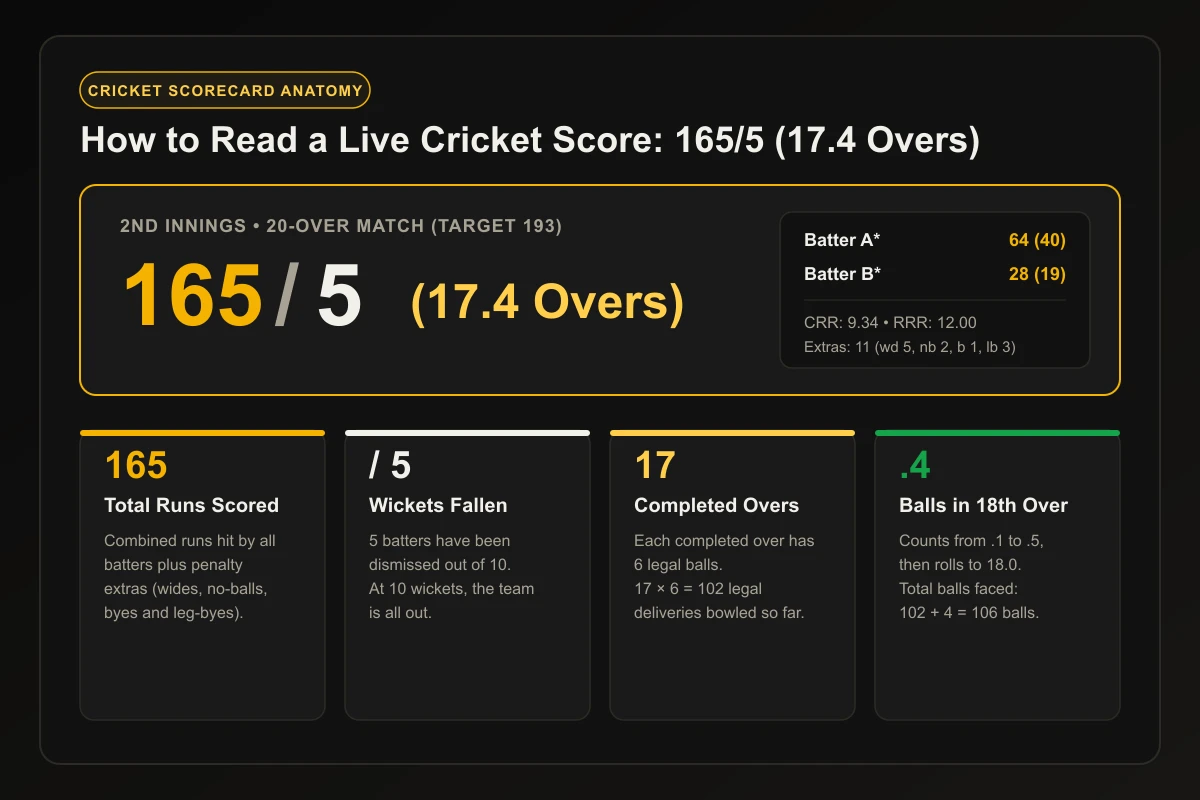
On every television broadcast graphic and live scorecard app, the headline score is written as two numbers separated by a slash (or hyphen), such as 165/5 (read aloud as "165 for 5").
- 165 (Total Runs): The first number is the batting team's cumulative runs in that innings. It includes every run scored off the bat by all batters who have played so far, plus all extras (penalty runs awarded for wides, no-balls, byes, and leg-byes).
- 5 (Wickets Fallen): The second number is how many batters have been dismissed (given out). A cricket team comprises 11 players, and batters always play in pairs, meaning a team's innings ends when 10 wickets fall ("all out").
| Score Format | How It Is Read | What It Tells You About the Innings |
|---|---|---|
| 165/5 | 165 runs for 5 wickets | The team has scored 165 runs; 5 batters are out and 5 wickets remain in hand. |
| 82/0 | 82 runs for no loss | Both opening batters are still at the crease; the bowling side has taken 0 wickets. |
| 210/10 (or 210 all out) | 210 runs, all out | 10 batters have been dismissed, leaving the 11th batter "not out" without a partner. |
| 415/7 d | 415 for 7 declared | In multi-day matches (Tests/first-class), the batting captain voluntarily closed the innings at 7 wickets down. |
Note on Australian scorecards: In Australia, traditional scoreboards reverse the two numbers and write 5/165 ("5 for 165"). It is easy to tell the difference because wickets in a single innings can never exceed 10.
2. What Overs and Notation Like 17.4 Overs Mean
Right next to the main score, you will see the overs count in brackets: 165/5 (17.4 overs).
In standard cricket formats—Twenty20 (20 overs per side), One-Day Internationals (50 overs per side), and Test cricket—one over consists of 6 legal balls (deliveries) bowled by a single bowler from one end of the pitch.
Because an over has 6 balls rather than 10, the dot in 17.4 overs is not a standard base-10 decimal. Instead, it separates completed overs from balls bowled in the current over:
- 17 = 17 completed overs (
17 × 6 = 102legal balls bowled). - .4 = 4 legal balls bowled in the 18th over.
- Total legal balls faced =
102 + 4 = 106balls.
As a bowler delivers an over, the counter advances like this:
- 17.0 overs — End of the 17th over (
102balls completed). - 17.1 overs — 1st legal ball of the 18th over.
- 17.2 overs — 2nd legal ball of the 18th over.
- 17.3 overs — 3rd legal ball of the 18th over.
- 17.4 overs — 4th legal ball of the 18th over.
- 17.5 overs — 5th legal ball of the 18th over.
- 18.0 overs — 6th legal ball completes the 18th over (
108balls completed).
You will never see .6, .7, .8, or .9 in the overs column of a standard 6-ball cricket scorecard. (In the 100-ball format covered in our The Hundred 2026 guide, scorecards simply count total balls from 1 to 100 instead of 6-ball overs.)
3. How Run Rate (CRR) Is Calculated (Worked Example)
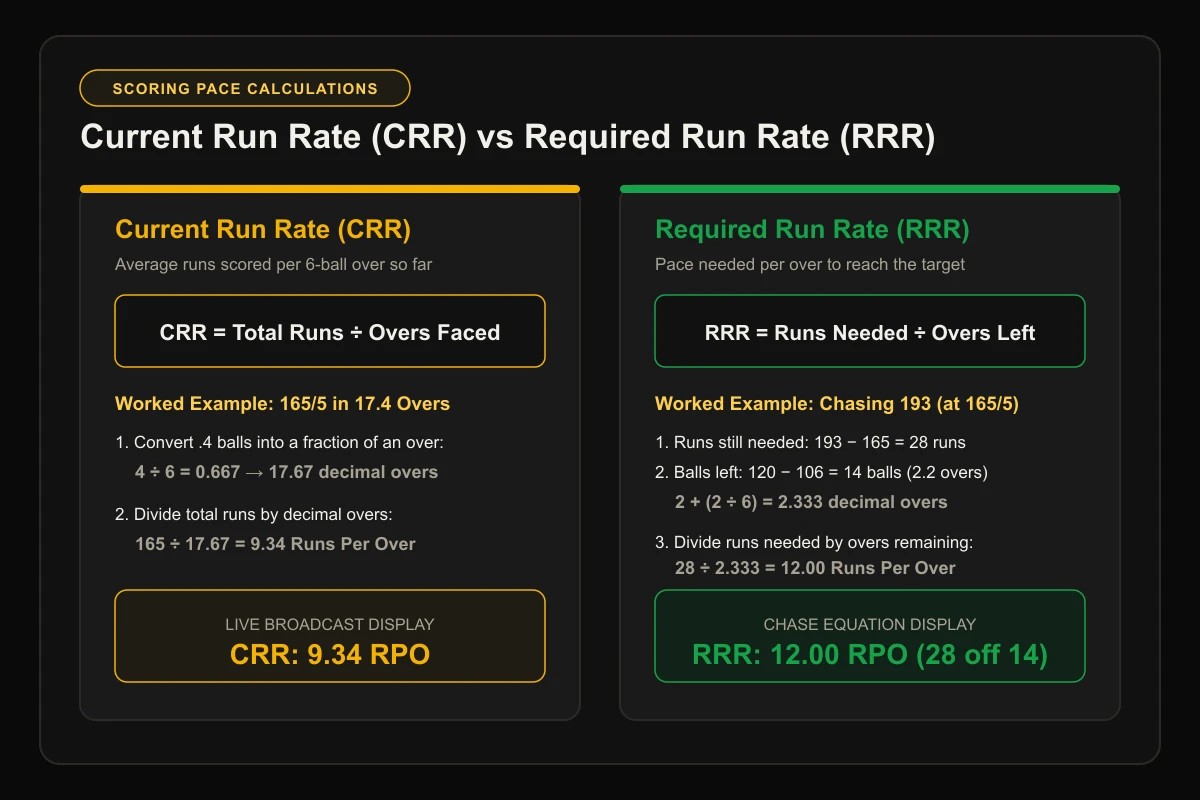
Run Rate—often labelled CRR (Current Run Rate)—measures the average number of runs the batting team has scored per 6-ball over across the innings so far.
Current Run Rate Formula:
Current Run Rate (CRR) = Total Runs Scored ÷ Total Overs Faced (in true decimal)
Step-by-Step Worked Example
Suppose a team's score is 165/5 after 17.4 overs:
- Convert the partial over (
.4balls) into a true fraction of 6 balls:
Since 4 balls out of 6 have been bowled in the 18th over, divide4by6:
4 ÷ 6 = 0.6667 overs
Add that to the 17 completed overs to get 17.6667 true decimal overs (or count total balls:106 balls ÷ 6 = 17.6667 overs). - Divide total runs by the decimal overs:
CRR = 165 ÷ 17.6667 = 9.34 runs per over (RPO)
A typical beginner mistake is dividing 165 by 17.4 on a calculator (9.48), which gives the wrong answer because .4 represents four-sixths of an over, not four-tenths. If you prefer working in balls, you can always use the equivalent ball-by-ball formula:
CRR = (Total Runs ÷ Total Legal Balls Faced) × 6 = (165 ÷ 106) × 6 = 9.34 RPO
4. How Required Run Rate (RRR) Is Calculated (Worked Example)
In the second innings of a limited-overs match (or the fourth innings of a Test match when overs are known), the team batting second is chasing a Target—which is always 1 run more than the first team's total.
Required Run Rate (RRR) tells you how many runs per over the chasing team must average across the remaining balls to win the match.
Required Run Rate Formula:
Required Run Rate (RRR) = Runs Still Needed to Win ÷ Overs Remaining (in true decimal)
Step-by-Step Worked Example
Suppose Team A scored 192/6 in their 20 overs. That sets Team B a target of 193 runs in 20 overs (120 balls). Team B's current score is 165/5 after 17.4 overs:
- Find the runs still needed:
193 − 165 = 28 runs needed - Find the legal balls and decimal overs remaining:
- Total balls in 20 overs =
120 balls - Balls already faced in
17.4 overs=(17 × 6) + 4 = 106 balls - Balls remaining =
120 − 106 = 14 balls(which is 2 overs and 2 balls, written as2.2 oversleft) - Convert
14 ballsto decimal overs:14 ÷ 6 = 2.3333 overs remaining
- Total balls in 20 overs =
- Divide runs needed by decimal overs remaining:
RRR = 28 ÷ 2.3333 = 12.00 runs per over (RPO)
Look at what comparing CRR (9.34) and RRR (12.00) tells you immediately: the chasing side has scored at 9.34 runs per over so far, and must now accelerate to 12.00 runs per over (equivalent to 2 runs per ball) over the final 14 balls to win.
5. What Extras Mean: Wides, No-Balls, Byes and Leg-Byes
Every full cricket scorecard includes a line called Extras beneath the individual batters' scores—for example:
Extras: 11 (b 1, lb 3, w 5, nb 2, p 0)
Extras are runs added to the team's total score that are not credited to any individual batter's personal score. They fall into two categories: bowling extras (penalties for illegal deliveries that must be re-bowled) and fielding extras (runs taken from legal deliveries where the bat did not hit the ball).
| Scorecard Code | Full Term | Type of Delivery | Charged to Bowler's Runs? | Must the Ball Be Re-Bowled? |
|---|---|---|---|---|
| w (or wd) | Wide | Ball bowled too far wide of the batter to be hit with a normal cricket stroke. | Yes (1 penalty run + any runs run by the batters) | Yes (does not count as 1 of the 6 legal balls) |
| nb | No-Ball | Illegal delivery (front-foot overstepping, dangerous high full toss, or fielding restriction breach). | Yes (1 penalty run; any runs hit off the bat go to the batter) | Yes (and triggers a Free Hit in limited-overs cricket) |
| b | Bye | A legal ball misses both the bat and the batter's body, and the batters run while the wicketkeeper misses or chases it. | No (charged only to team extras) | No (counts as a legal ball) |
| lb | Leg-Bye | A legal ball deflects off the batter's pads or body (not the bat) while attempting a shot or evading the ball, and the batters run. | No (charged only to team extras) | No (counts as a legal ball) |
| p | Penalty Runs | Rare 5-run penalty awarded by the umpires (for example, if the ball strikes a helmet left on the field). | No | No |
Understanding extras explains why the individual batters' scores on a scorecard do not add up to the team total on their own: Sum of All Batters' Runs + Total Extras = Team Total.
6. Batting Scorecard Statistics: Runs, Balls, Fours, Sixes and Strike Rate
The batting table lists all 11 players in batting order, how each batter was dismissed (such as c Keeper b Bowler, b Bowler, lbw b Bowler, run out, or not out), and five numerical columns:
| Column | Meaning | Worked Example (Opener A: 64* off 40 balls) |
|---|---|---|
| R | Runs scored by that batter off the bat. An asterisk (64*) means the batter is not out. |
64* (scored 64 runs and is still batting or finished the innings unbeaten). |
| B | Balls faced by that batter (includes legal deliveries and no-balls faced, but excludes wides). | 40 deliveries faced. |
| 4s | Boundary Fours — times the batter hit the ball along the ground across the boundary rope for 4 runs. | 6 fours (6 × 4 = 24 runs from fours). |
| 6s | Boundary Sixes — times the batter hit the ball over the boundary rope on the full for 6 runs. | 3 sixes (3 × 6 = 18 runs from sixes). |
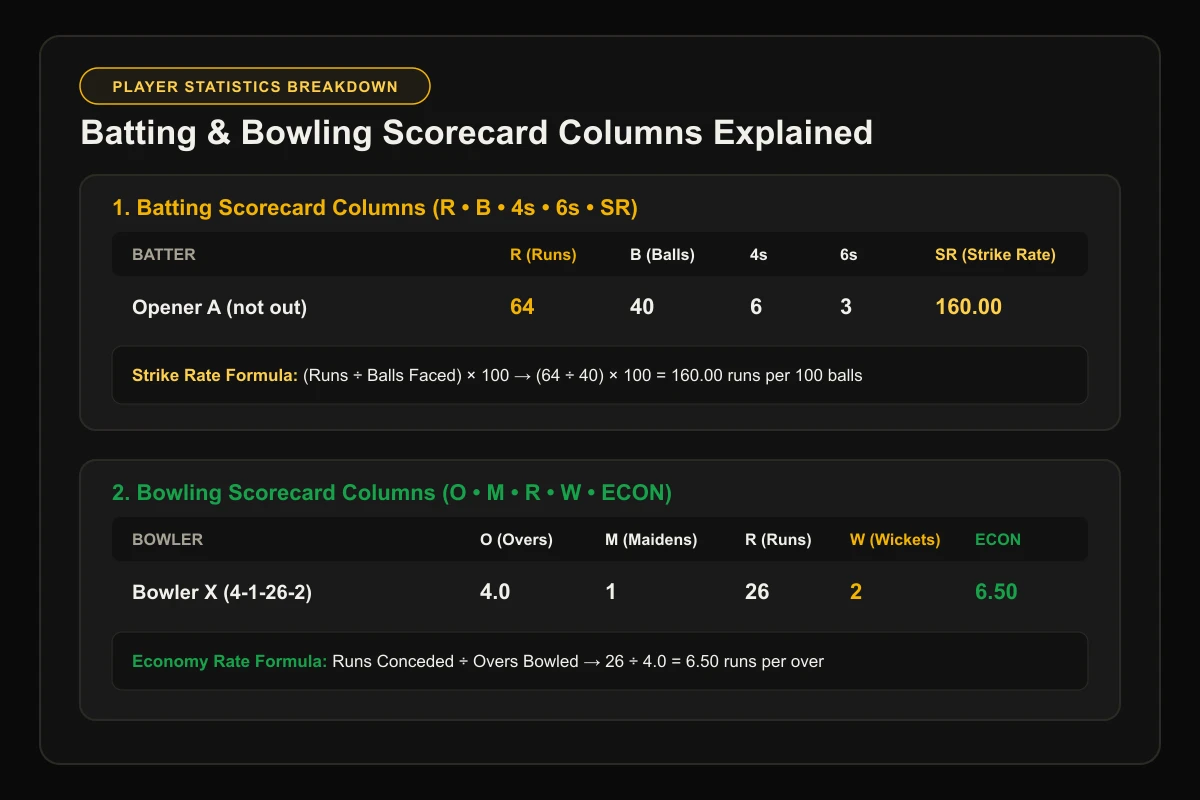
| SR | Batting Strike Rate — average runs scored by that batter per 100 balls faced. | 160.00 ((64 ÷ 40) × 100 = 160.00). |
How Batting Strike Rate (SR) Is Calculated
Batting Strike Rate Formula:
Batting Strike Rate (SR) = (Runs Scored by Batter ÷ Balls Faced) × 100
- If a batter scores 64 runs off 40 balls, their strike rate is
(64 ÷ 40) × 100 = 160.00. - A strike rate of 100.00 means exactly run-a-ball pace (1 run per delivery).
- In T20 cricket (such as matches covered in our India vs New Zealand 3rd T20I preview), top-order strike rates frequently sit between 130.00 and 180.00+, whereas in multi-day Test cricket, batters prioritise occupying the crease and often bat at strike rates between 45.00 and 70.00.
7. Bowling Scorecard Statistics: Overs, Maidens, Runs, Wickets and Economy
Below the batting table sits the bowling table, which records the figures for every bowler used by the fielding side. On television summaries, a bowler's figures are often written in shorthand as 4-1-26-2 (Overs–Maidens–Runs–Wickets).
| Column | Meaning | Worked Example (4.0 - 1 - 26 - 2) |
|---|---|---|
| O | Overs bowled by that bowler (using .1 to .5 notation for incomplete overs). |
4.0 overs (24 legal deliveries). |
| M | Maiden overs — completed 6-ball overs in which zero runs were scored off the bat or from bowling extras (wides/no-balls). | 1 maiden over bowled. |
| R | Runs conceded off that bowler's deliveries (includes runs hit off the bat plus any wides and no-balls bowled by them; excludes byes and leg-byes). | 26 runs conceded. |
| W | Wickets taken attributed to the bowler (bowled, caught, LBW, stumped, or hit wicket; excludes run-outs). | 2 wickets taken. |
| ECON | Economy Rate — average number of runs conceded by that bowler per 6-ball over. | 6.50 (26 runs ÷ 4.0 overs = 6.50). |
How Bowling Economy Rate (ECON) Is Calculated
Bowling Economy Rate Formula:
Bowling Economy Rate (ECON) = Runs Conceded by Bowler ÷ Overs Bowled (in true decimal)
- If a bowler finishes with 4 overs for 26 runs, their economy rate is
26 ÷ 4 = 6.50runs per over. - If a bowler has bowled an incomplete over—say 3.3 overs for 21 runs—convert
.3balls to3 ÷ 6 = 0.5overs (3.5true decimal overs), then calculate21 ÷ 3.5 = 6.00runs per over. - Unlike batting strike rate (where higher is faster), a lower bowling economy rate is better for the bowling team because it means the bowler is restricting scoring.
8. How Viewers Can Use These Numbers to Read a Live Match
When you open a live scorecard on your phone or follow live in-play coverage through our Fairplay Live India guide, combining three numbers gives you the full tactical picture of the match:
1. Wickets in Hand vs Overs Remaining
A score of 120/1 after 14.0 overs in a T20 match looks modest at first glance (CRR 8.57), but because the batting team still has 9 wickets in hand for the final 6 overs (36 balls), they can attack freely without fear of being bowled out. By contrast, 120/6 after 14.0 overs has the exact same run rate (8.57), yet the batting team is in trouble because the lower order must protect the last 4 wickets.
2. The Gap Between CRR and RRR
In a run chase, watch the spread between Current Run Rate and Required Run Rate:
- RRR below 6.00 in ODIs or below 8.00 in T20s (with 6+ wickets in hand): the chasing team can reach the target chiefly through singles and twos without taking high-risk boundary shots.
- RRR climbing past 12.00 to 15.00+ in T20s: the batters must hit at least two boundaries every over, which dramatically increases wicket-taking opportunities for the bowlers.
3. Key Bowlers' Remaining Overs
Always check the O (Overs) column in the bowling table during the closing stages of a white-ball match:
- In a T20 match, each bowler is allowed a maximum of 4 overs.
- In a 50-over ODI, each bowler is allowed a maximum of 10 overs.
If the chasing side needs 30 runs off the last 3 overs (RRR 10.00) and the bowling team's best fast bowlers have already completed their 4.0-over quota, the captain must turn to part-time or higher-economy bowlers—tilting the balance toward the batters.
4. Fall of Wickets (FoW) and Partnerships
At the bottom of the batting table, look for Fall of Wickets (FoW), written as:
Fall of Wickets: 1-24 (Opener B, 3.1 ov), 2-88 (Number 3, 10.2 ov), 3-92 (Number 4, 11.0 ov)
This timeline shows you whether wickets fell in clusters (such as 2-88 and 3-92 within four balls of each other, stalling momentum) or whether two batters built a long partnership (such as 64 runs added between 1-24 and 2-88).
If you are setting up your account to follow live cricket action, you can also review our what is Fairplay ID guide, check the Fairplay New ID signup guide, or visit the Fairplay Login guide for account-access help.
Need a Fairplay or Fairplay24 ID?
Message our support team on WhatsApp for fast account setup. Deposits supported via UPI, Bank Transfer, and USDT.
Get Your Fairplay ID on WhatsAppFrequently Asked Questions
Why does a cricket over go from 17.5 to 18.0 instead of 17.6?
.1 to .5. When the 6th legal ball is completed, the over finishes and the counter rolls over to the next whole number (18.0).What does an asterisk (*) next to a batter's score mean?
Why is a cricket team all out at 10 wickets when there are 11 players?
Do wides and no-balls count as balls faced by a batter?
B column (since the batter can hit and score runs off a no-ball), even though the bowler must re-bowl the delivery for the over count.What is the difference between batting strike rate and bowling strike rate?
How do you read bowling figures like 4-1-26-2?
4-1-26-2 means the bowler bowled 4 overs, including 1 maiden over (0 runs off it), conceded 26 runs in total, and took 2 wickets.