Net Run Rate (NRR) is the standard statistical method used in limited-overs cricket tournaments to measure how fast a team scores its runs per over compared with how fast its opponents score per over across the tournament. When two or more teams finish level on points in a league table or World Cup group stage, Net Run Rate is the primary metric used in most competitions to decide which team finishes higher and qualifies for the knockout rounds.
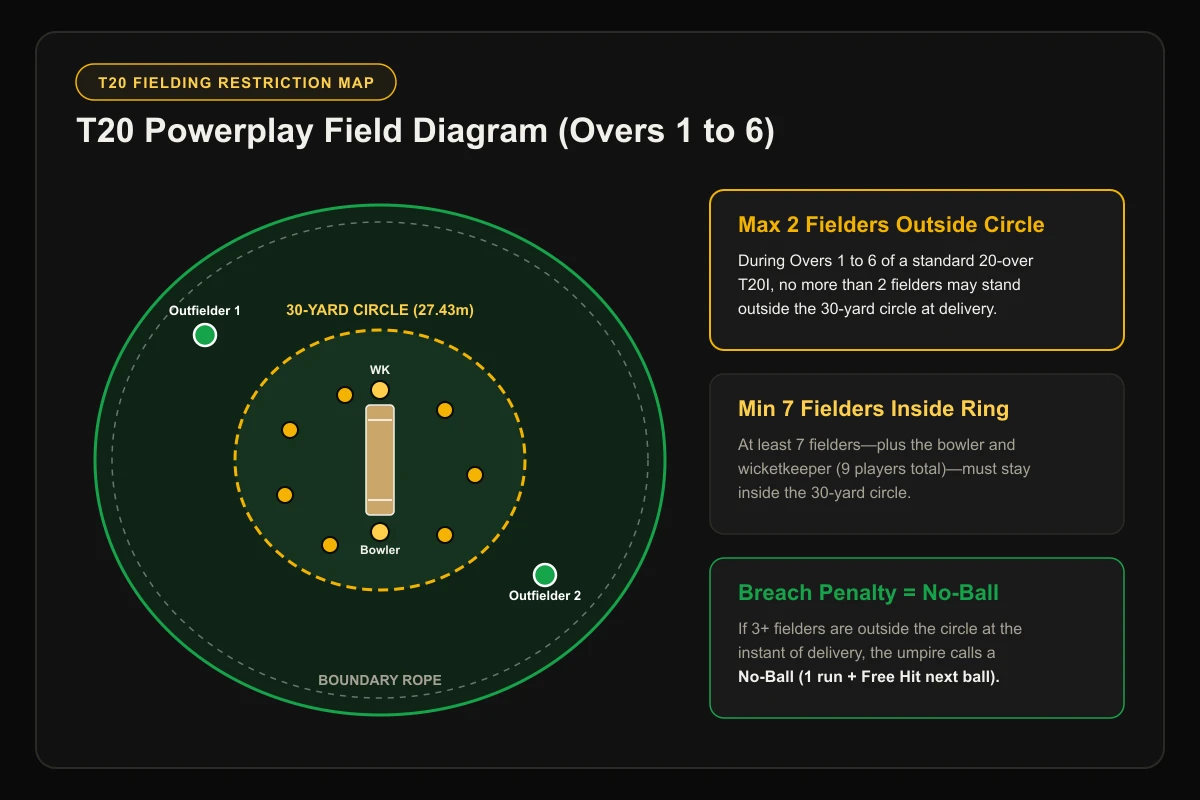
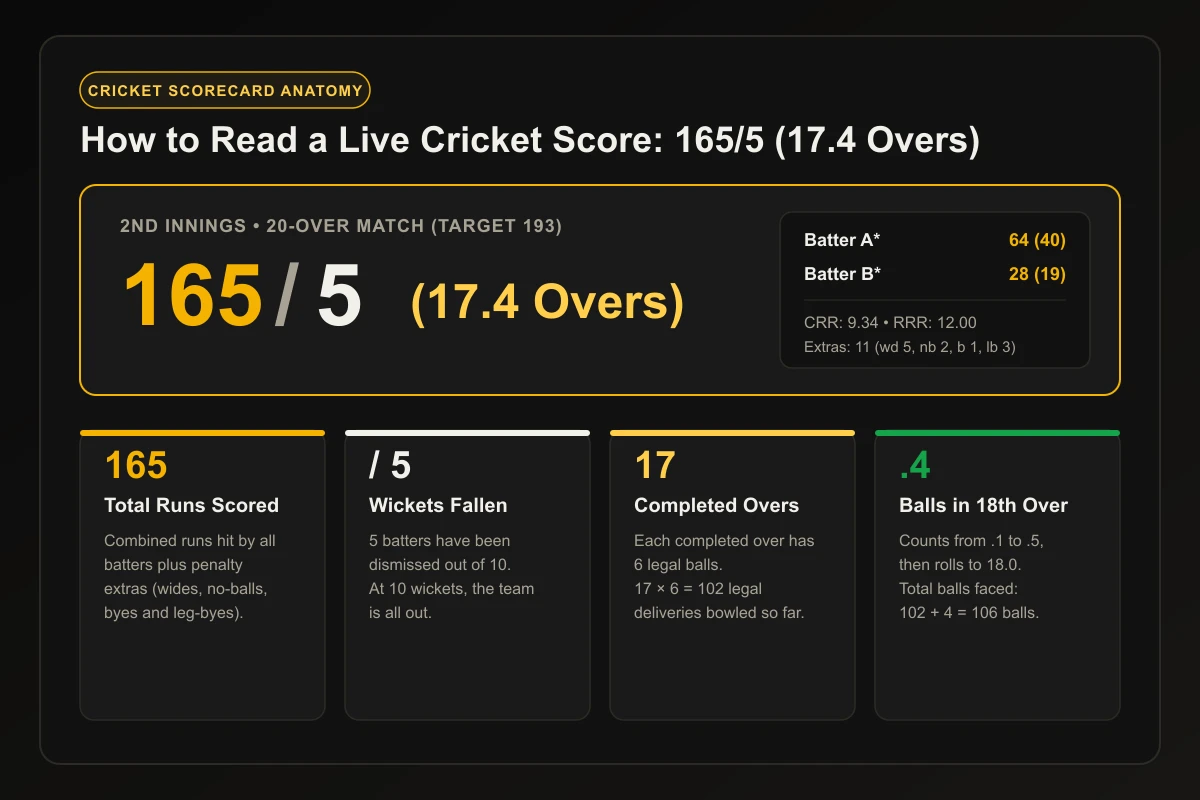
If you already know how single-innings Run Rate (CRR) works from our how to read a cricket scorecard guide and understand how teams attack the opening overs in our T20 powerplay rules guide, this guide walks through the official Net Run Rate formula, the all-out full-quota overs rule, step-by-step worked examples, and how teams boost their NRR in tournament play.
1. What Is Net Run Rate in Cricket?
In a single cricket innings, Run Rate is simply the batting side's average runs scored per 6-ball over (Runs ÷ Overs). Net Run Rate (NRR) takes that concept across an entire match or multi-match tournament by subtracting a team's bowling run rate conceded from its batting run rate scored:
- Positive Net Run Rate (e.g.
+1.000): The team scores more runs per over than it concedes to its opponents. - Zero Net Run Rate (
0.000): The team scores and concedes at the exact same rate per over. - Negative Net Run Rate (e.g.
-0.750): The team concedes more runs per over than it scores.
Run Rate vs Net Run Rate: Do Not Confuse the Two
| Metric | Where You See It | What It Measures | Can It Be Negative? |
|---|---|---|---|
| Current Run Rate (CRR) | On a live match scorecard during an innings | Average runs per over scored by one batting team in that specific innings (Runs ÷ Overs Faced). |
No (always 0.00 or positive). |
| Required Run Rate (RRR) | On a live match scorecard during the 2nd innings chase | Average runs per over the chasing team needs over the remaining balls to reach the target. | No. |
| Net Run Rate (NRR) | On a tournament points table / standings | A team's cumulative scoring rate per over minus its cumulative rate conceded per over across all completed matches. | Yes (positive + or negative −, usually shown to 3 decimal places). |
2. Net Run Rate Formula
Under official ICC tournament playing conditions (standard across the ICC Men's T20 World Cup, ICC Cricket World Cup, Champions Trophy, and major domestic leagues), a team's Net Run Rate is defined as:
Net Run Rate (NRR) Formula:
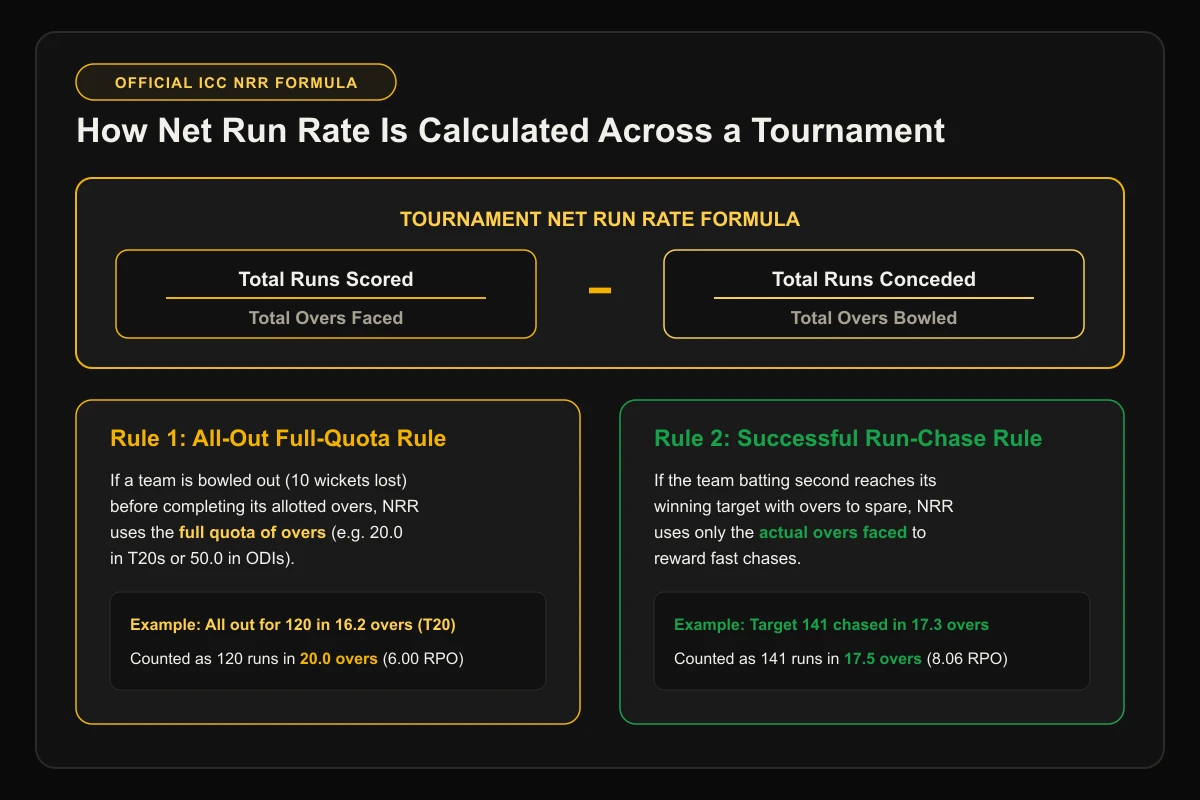
Net Run Rate = (Total Runs Scored in Tournament ÷ Total Overs Faced) − (Total Runs Conceded in Tournament ÷ Total Overs Bowled)
There are two critical rules built into this formula:
- Cumulative Totals Across the Tournament (Never Average Match NRRs):
To calculate a team's tournament NRR after several matches, you add together every run the team has scored across all completed matches and divide by the sum of all overs counted as faced, then subtract all runs conceded across all matches divided by all overs counted as bowled. You do not take a simple arithmetic average of each individual match's NRR. - Convert Partial Overs (
.1to.5Balls) to True Fractions of 6:
Just as in single-innings run rate, an over consists of 6 legal deliveries. When an innings ends partway through an over:.1over (1 ball) =1 ÷ 6 = 0.1667overs.2overs (2 balls) =2 ÷ 6 = 0.3333overs.3overs (3 balls) =3 ÷ 6 = 0.5000overs.4overs (4 balls) =4 ÷ 6 = 0.6667overs.5overs (5 balls) =5 ÷ 6 = 0.8333overs
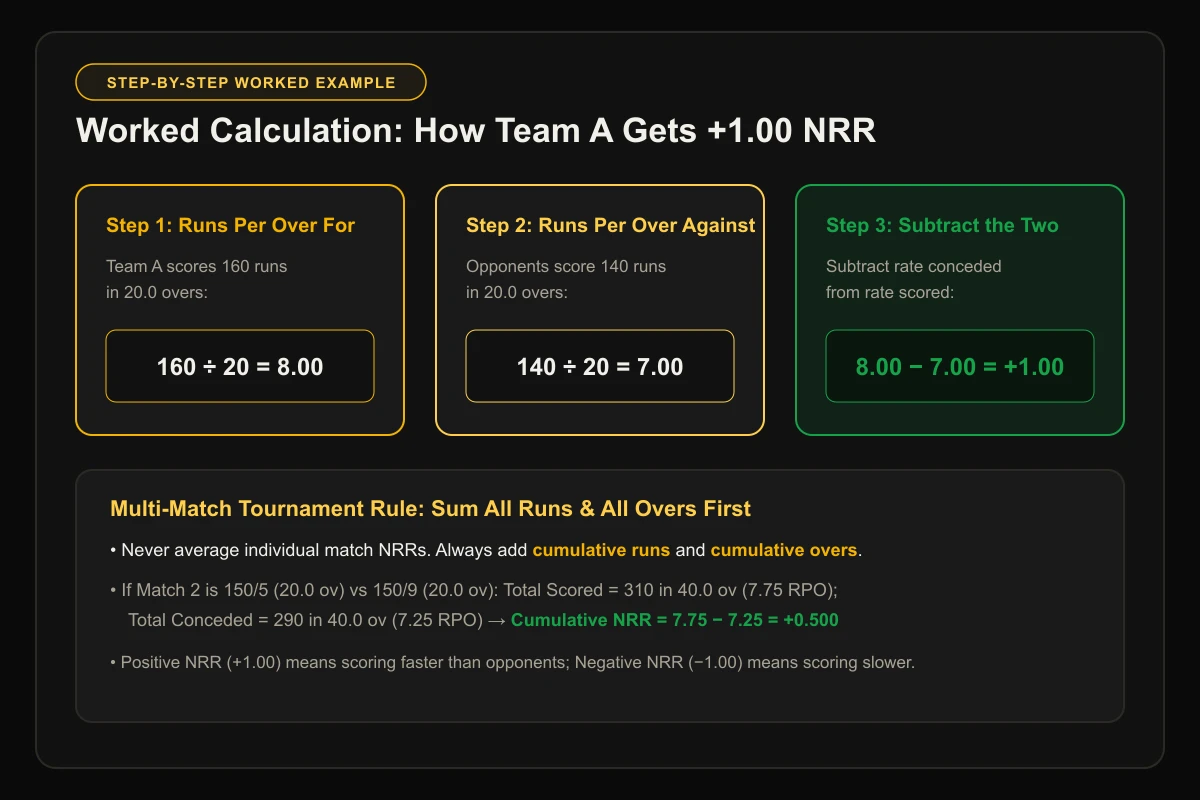
3. Worked Calculation Example (+1.00 NRR)
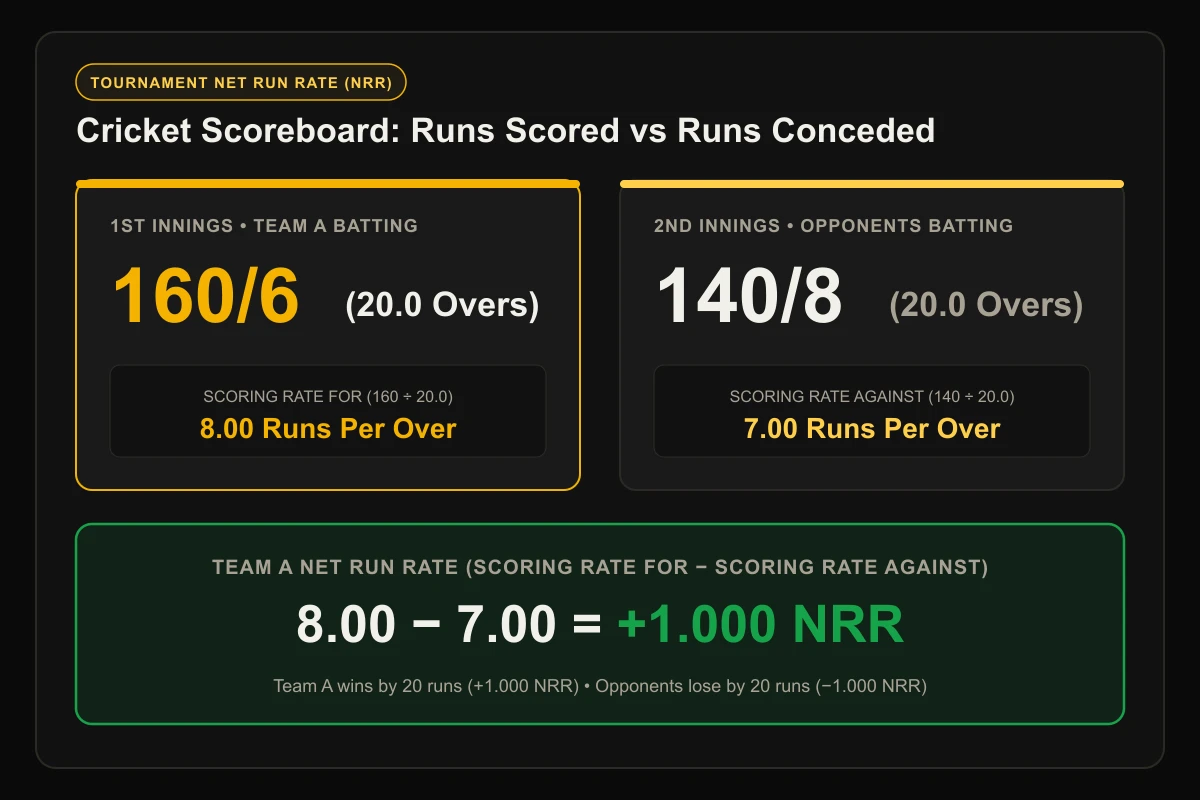
Let's walk through a clear, single-match 20-over T20 calculation where neither side is bowled out early and the full 20 overs are completed in both innings:
- Team A (Batting First): Scores 160/6 in 20.0 overs.
- Opponents (Batting Second): Score 140/8 in 20.0 overs (Team A wins by 20 runs).
Step-by-Step Calculation for Team A
- Calculate Team A's Scoring Rate (Runs Per Over For):
Scoring Rate For = 160 ÷ 20.0 = 8.00 runs per over - Calculate Team A's Conceded Rate (Runs Per Over Against):
Scoring Rate Against = 140 ÷ 20.0 = 7.00 runs per over - Subtract Conceded Rate from Scoring Rate:
Team A's NRR = 8.00 − 7.00 = +1.00 (written on tables as +1.000)
For the opponents in that same match, the numbers are reversed (7.00 − 8.00), giving the losing team an NRR of -1.00 (-1.000).
Extending the Example to Match 2 (Cumulative Tournament NRR)
Now suppose Team A plays a second 20-over match in the tournament:
- Match 2: Team A scores 150/5 in 20.0 overs, and their Match 2 opponents score 150/9 in 20.0 overs (or suppose Team A wins a tight game 152/5 in 20.0 overs vs 148/7 in 20.0 overs).
- Let's use 152/5 (20.0 overs) vs 148/7 (20.0 overs) for Match 2:
- Cumulative Runs Scored by Team A:
160 + 152 = 312 runs - Cumulative Overs Faced by Team A:
20.0 + 20.0 = 40.0 overs→312 ÷ 40.0 = 7.80 RPO - Cumulative Runs Conceded by Team A:
140 + 148 = 288 runs - Cumulative Overs Bowled by Team A:
20.0 + 20.0 = 40.0 overs→288 ÷ 40.0 = 7.20 RPO - Team A's Cumulative Tournament NRR:
7.80 − 7.20 = +0.600
- Cumulative Runs Scored by Team A:
4. What Happens When a Team Is All Out Before Completing Its Overs?
This is the single most important rule in Net Run Rate calculations—and the one that surprises new viewers the most.
Under official ICC tournament regulations:
The All-Out Full-Quota Overs Rule:
If a team is bowled out (loses all 10 wickets) in less than its full quota of allotted overs, the calculation of its Net Run Rate uses the full quota of overs to which it would have been entitled (for example, 20.0 overs in a T20 match or 50.0 overs in an ODI)—not the number of overs at which the team was dismissed.
Why Does This Rule Exist?
Suppose Team B is bowled out for 100 runs in 10.0 overs of a 20-over T20 match.
- If NRR divided by the
10.0overs actually faced, Team B would be credited with a batting run rate of100 ÷ 10.0 = 10.00 RPO—making an all-out collapse look faster than a team that scored180/4across the full20.0overs (9.00 RPO)! - By charging Team B for the full 20.0 overs they were entitled to bat, their batting rate is calculated as
100 ÷ 20.0 = 5.00 RPO. Being bowled out early always penalises the batting team and rewards the bowling team.
Worked Comparison: All Out Early vs Successful Run Chase
Compare how the overs denominator works in two different endings to a 20-over T20 match:
| Scenario | Actual Score on Scorecard | Overs Counted for NRR | Effective Scoring Rate Used in NRR | Why? |
|---|---|---|---|---|
| Scenario A: Team is All Out Early | 120 all out (120/10) in 16.2 overs | 20.0 overs (full allotted quota) | 120 ÷ 20.0 = 6.00 RPO |
Losing all 10 wickets forfeits the remaining 3.4 overs; full 20-over quota is charged. |
| Scenario B: Chasing Team Wins Early | Chasing 141, finishes at 141/3 in 17.3 overs | 17.5 overs (17 + 3/6 actual overs faced) |
141 ÷ 17.5 = 8.06 RPO |
The chasing team still had 7 wickets in hand and only needed 17.3 overs to win. |
5. Why NRR Matters in Tournament Standings
In bilateral series (such as the five-match series in our India vs West Indies T20I series hub or the India Tour of New Zealand 2026), the winner is simply the team that wins the most matches.
In multi-team round-robin tournaments and group stages—such as the ICC T20 World Cup, ICC ODI World Cup, Women's Asia Cup (covered in our India Women vs Sri Lanka Women Final article), and franchise leagues—teams play a fixed number of group matches and earn 2 points for a win, 1 point for a tie/no-result, and 0 points for a loss.
Because group stages are short (often 3 to 5 matches in a World Cup group, or 10 to 14 matches in a franchise league), two or three teams regularly finish on the exact same number of points.
Note on Tournament Tie-Breaking Orders
While Net Run Rate is the best-known tie-breaker in limited-overs cricket, always check the specific competition's official playing conditions, as tie-breaking hierarchies can vary:
- Typical ICC World Cup Group Tie-Breaker Order:
- Most points in the group.
- Higher number of wins in the group.
- Higher Net Run Rate (NRR) in the group.
- Head-to-head result between the tied teams.
- Pre-tournament seeding.
- Some domestic leagues place Net Run Rate directly at #2 (ahead of total wins if a team had a washout) or use head-to-head record first. Never assume one tournament's tie-breaker order applies universally without checking that event's regulations.
6. How a Team Can Improve Its Net Run Rate
Because NRR compares cumulative runs per over scored against cumulative runs per over conceded, teams looking to boost their NRR before the final round of group matches focus on four tactical levers:
- When Batting First: Win by the Largest Possible Run Margin (or Bowl the Opponent Out)
Every run saved in the second innings directly lowers the opponent's runs-per-over. Even better, taking the 10th wicket invokes the full-quota rule: whether you bowl the opposition out for 110 in 14.0 overs or 110 in 19.5 overs, they are charged for the full 20.0 overs in the NRR denominator (110 ÷ 20.0 = 5.50 RPO). - When Batting Second (Chasing): Reach the Target in as Few Balls as Possible
When chasing a modest target—say 121 in 20 overs—winning at121/2 in 12.0 oversgives a match scoring rate of10.08 RPO(and counts only12.0overs in your cumulative overs faced), whereas cruising to121/2 in 19.0 oversgives only6.37 RPO. - Avoid Being Bowled Out When Losing
If a chasing team realises in the 18th over that the target is out of reach, surviving to 145/8 after 20.0 overs and scoring as many late runs as possible hurts their tournament NRR far less than collapsing to 130 all out in 17.4 overs (which still gets divided by the full 20.0 overs). - How Rain-Interrupted (DLS) and Abandoned Matches Affect NRR
- Abandoned / No-Result Matches: If a match is washed out without a result, zero runs and zero overs are added to either team's NRR record.
- Duckworth-Lewis-Stern (DLS) Completed Matches: Under ICC regulations, if a match is interrupted by rain and decided by a revised DLS target, Team 1 is credited for NRR purposes with 1 run less than the final Target Score set for Team 2, off the same number of overs allocated to Team 2. For example, if Team 2 is set a revised DLS target of
95 runs in 10.0 overs, Team 1 is recorded in the NRR formula as having scored94 runs in 10.0 overs.
For live cricket follow-ups and account guides, see our Fairplay Live India guide, read what Fairplay ID is, check the Fairplay New ID signup guide, or visit the Fairplay Login guide.
Official Sources & Rule References
- ICC Men's Twenty20 World Cup & Men's ODI Playing Conditions (Tournament Points Table & Net Run Rate Clauses, e.g., Clause 16.10.2): Official definition of Net Run Rate (
average runs per over scored minus average runs per over conceded), the all-out full-quota overs rule, and the DLS par-score adjustment for rain-interrupted matches.
Need a Fairplay or Fairplay24 ID?
Message our support team on WhatsApp for fast account setup. Deposits supported via UPI, Bank Transfer, and USDT.
Get Your Fairplay ID on WhatsApp