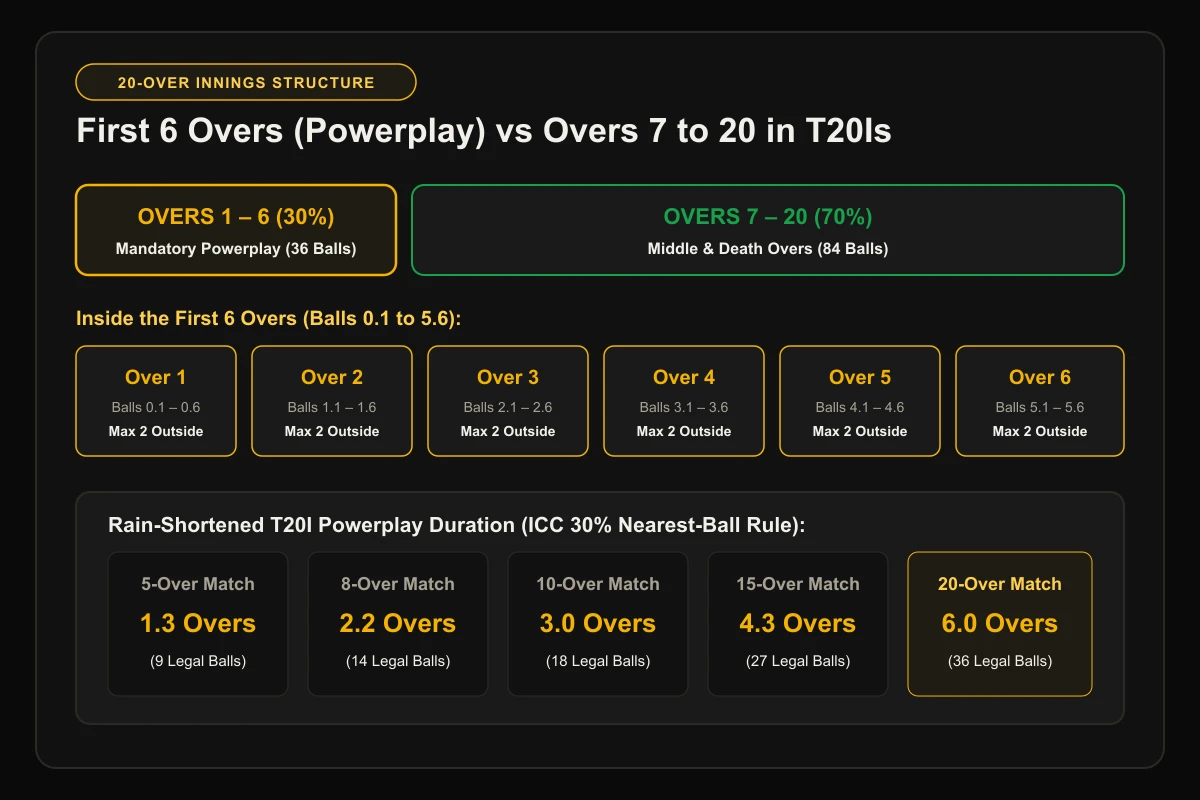
In T20 cricket, the Powerplay is the mandatory opening phase of an innings where strict fielding restrictions force the bowling team to keep most of its fielders inside the 30-yard circle. In a standard, uninterrupted 20-over Men's T20 International (T20I), the powerplay lasts for the first 6 overs (36 legal balls), during which a maximum of 2 fielders are permitted outside the 30-yard circle. Once the 6th over finishes, the restriction relaxes and up to 5 fielders may move outside the circle for overs 7 to 20.
Understanding how powerplay overs work—and how rain delays, slow over-rate penalties, and league-specific rules alter them—helps you read momentum shifts in any T20 match, whether you are following an international series like the India Tour of New Zealand 2026, checking a live scorecard with our how to read a cricket scorecard guide, or browsing our Fairplay Cricket ID guide.
1. What Is a T20 Powerplay?
A Powerplay is a block of overs governed by special fielding-restriction clauses in the playing conditions. In cricket, a fielding side has 11 players on the ground:
- 1 Bowler
- 1 Wicketkeeper
- 9 Fielders
Left unrestricted, a defensive captain in a 20-over match could station almost all 9 fielders along the boundary rope from ball one, making fours and sixes nearly impossible to hit. To prevent negative tactics and reward positive stroke-play with the hard new ball, the playing conditions draw a painted oval—known as the 30-yard circle (27.43 metres)—around the centre pitch and cap how many fielders can stand outside it.
By forcing 7 of the 9 fielders to stay inside the 30-yard ring during the opening overs, the powerplay opens large gaps in the outfield. Batters who clear the infield ring have a high probability of finding the boundary, while bowlers are encouraged to pitch the new ball up and hunt for early wickets.
2. How Many Overs Does a Standard Men's T20 International Powerplay Last?
Under Clause 28.7 of the ICC Men's Twenty20 International Playing Conditions, a full 20-over innings has one mandatory Powerplay block:
- Duration: 6.0 overs (Overs 1 to 6, or the first 36 legal deliveries of the innings).
- Share of the Innings: Exactly 30% of a 20-over innings.
- Applies to Both Innings: Both the team batting first and the team chasing in the second innings receive the same 6-over opening powerplay (unless the match is shortened by weather).
Standard Men's T20Is vs Other Domestic T20 Competitions
Not every short-format cricket league uses the exact same 6-over structure. Always distinguish standard ICC T20 International rules from domestic franchise variations:
| Competition / Format | Total Innings Length | Powerplay Structure | Key Difference from Standard Men's T20I |
|---|---|---|---|
| ICC Men's T20I & T20 World Cup | 20 overs (120 balls) | Overs 1–6 (6 continuous overs at the start) | Standard benchmark under ICC Clause 28.7. |
| Indian Premier League (IPL) | 20 overs (120 balls) | Overs 1–6 (6 continuous overs at the start) | Follows the same 6-over opening powerplay structure as ICC Men's T20Is. |
| Big Bash League (BBL, Australia) | 20 overs (120 balls) | 4-over opening Powerplay (Overs 1–4) + 2-over floating Power Surge | The final 2 powerplay overs ("Power Surge") are called by the batting team at the start of any over from Over 11 onwards. |
| The Hundred (England & Wales) | 100 balls | First 25 balls | Uses 5-ball/10-ball sets instead of 6-ball overs; see our The Hundred 2026 guide. |
3. Fielding Restrictions During the Powerplay (Overs 1 to 6)
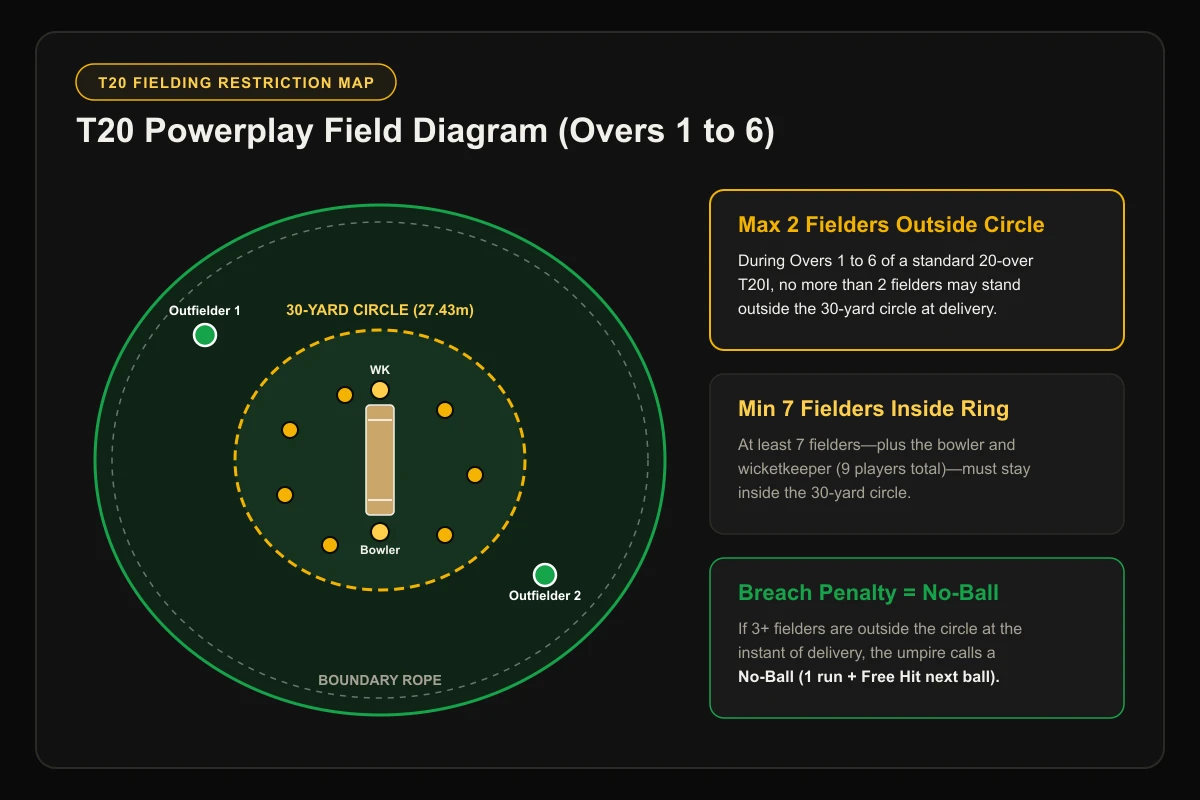
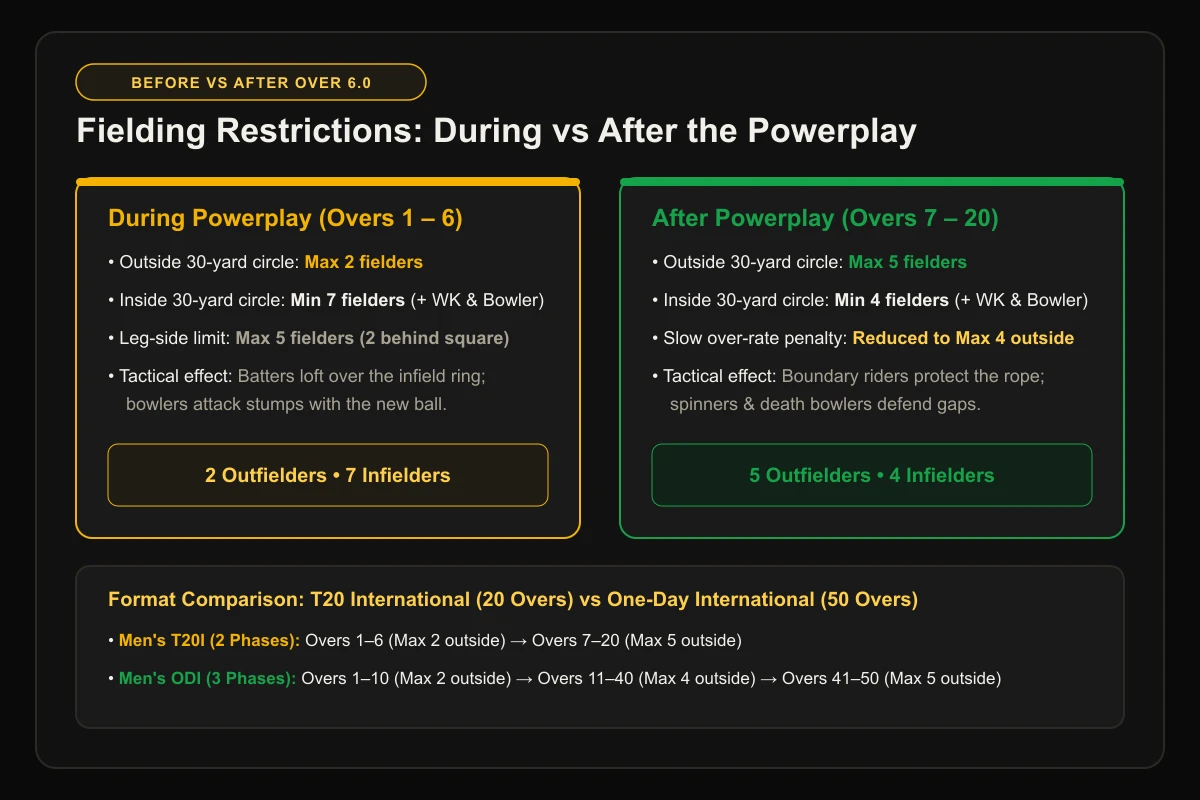
During the first 6 overs of a standard 20-over T20 International, the fielding captain must obey three positional rules at the instant of delivery (the moment the bowler releases the ball):
- Maximum 2 Fielders Outside the 30-Yard Circle: No more than 2 fielders may be stationed outside the 30-yard fielding restriction circle.
- Minimum 7 Fielders Inside the 30-Yard Circle: Because only 2 of the 9 fielders are allowed in the deep, at least 7 fielders—plus the bowler and wicketkeeper (9 players in total)—must be positioned inside (or on the line of) the 30-yard circle. (Note: under contemporary ICC T20I playing conditions, there is no longer a separate requirement for two stationary close catchers inside a 15-yard circle.)
- Standard Leg-Side (On-Side) Limits Still Apply: Under Law 28.4 / ICC Clause 28.4, at the instant of delivery there may never be more than 5 fielders on the leg side, and no more than 2 fielders behind the popping crease (behind square) on the leg side.
What Is the 30-Yard Circle?
The 30-yard circle is not a true geometric circle. Under ICC specifications, it is formed by drawing two semicircles with a radius of 30 yards (27.43 metres) centred on the middle stump at each end of the pitch, joined by two straight parallel lines running alongside the pitch. It is marked on the outfield grass by painted white dots or solid white arcs.
What Happens If the Fielding Team Breaks a Powerplay Rule?
If a 3rd fielder steps outside the 30-yard circle before the ball is released—or if more than 5 fielders are on the leg side—either umpire calls and signals No-Ball:
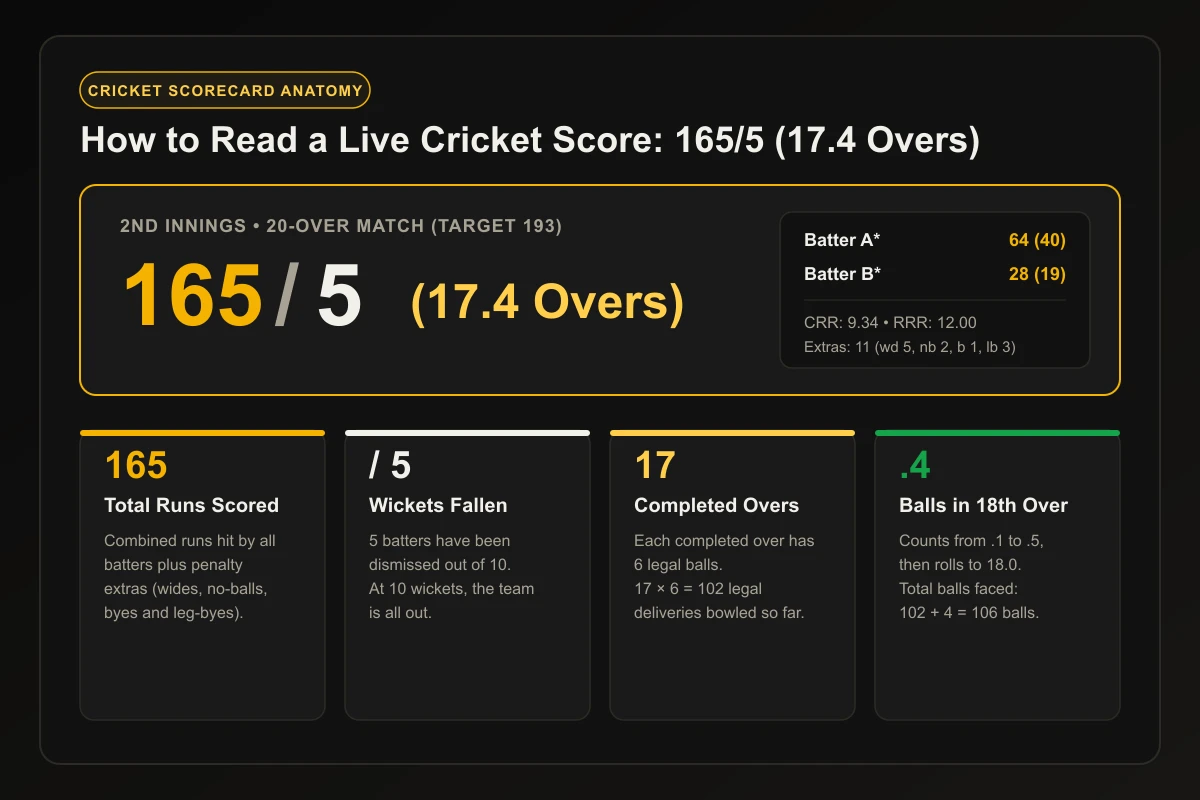
- The batting team is awarded 1 penalty run immediately (recorded under Extras, as explained in our cricket scorecard guide).
- The delivery does not count as one of the 6 legal balls of the over and must be re-bowled.
- The very next delivery becomes a Free Hit, during which the batter cannot be dismissed by any method other than those permitted on a no-ball (primarily Run Out).
4. Fielding Restrictions After the Powerplay (Overs 7 to 20)
As soon as the 6th legal ball of the 6th over is completed (6.0 overs), the mandatory Powerplay ends. For the remaining 14 overs (Overs 7 to 20) of a full 20-over T20I innings:
- Maximum 5 Fielders Outside the 30-Yard Circle: The fielding captain may push up to 3 additional fielders back to the boundary, bringing the maximum number of outfielders outside the 30-yard circle to 5.
- Minimum 4 Fielders Inside the 30-Yard Circle: At least 4 fielders (plus the bowler and wicketkeeper) must remain inside the 30-yard ring.
- Leg-Side Limit Unchanged: The maximum of 5 fielders on the leg side (and maximum 2 behind square on the leg side) continues to apply on every ball of the match.
The In-Match Slow Over-Rate Fielding Penalty (Max 4 Outside)
Since 2022, ICC T20 International playing conditions include an in-match over-rate penalty (Clause 41.11 / Clause 13.8):
- Each fielding team is given a scheduled cut-off time (typically 85 minutes, plus any approved umpire allowances for injuries, DRS reviews, or ball retrievals) to begin the 20th and final over.
- If the fielding side is behind the required over rate when the cut-off clock expires, they are penalised for every remaining over started after the cut-off time: only 4 fielders (instead of 5) are allowed outside the 30-yard circle for the rest of the innings.
Having an extra fielder forced inside the circle during the 19th or 20th over is a major tactical blow when defending a tight target.
5. How Rain-Affected or Shortened Innings Change Powerplay Overs
When rain, wet outfields, or bad light reduces a T20 match to fewer than 20 overs per side (down to the minimum 5 overs per side required to constitute a valid T20 International), a full 6-over powerplay would be unfair to the bowling side. Instead, the powerplay is scaled proportionally to 30% of the shortened innings.
Historically, the ICC rounded shortened T20I powerplays to the nearest full over (for example, an 8-over innings had a 2.0-over powerplay, while a 9-over innings jumped to a 3.0-over powerplay). In 2025, the ICC updated Clause 28.7 of the Men's T20I Playing Conditions to calculate shortened-innings powerplays to the nearest single ball (delivery) so the powerplay stays as close to 30% as possible—matching the method already used in T20 leagues like The Blast.
Official ICC Men's T20I Shortened-Innings Powerplay Table
| Total Overs in Innings | Total Legal Balls | Powerplay Duration (Nearest-Ball Rule) | Legal Balls in Powerplay | Legacy Full-Over Table (For Reference) |
|---|---|---|---|---|
| 5 overs | 30 balls | 1.3 overs | 9 balls (30.0%) | 2.0 overs (12 balls) |
| 6 overs | 36 balls | 1.5 overs | 11 balls (30.6%) | 2.0 overs (12 balls) |
| 7 overs | 42 balls | 2.1 overs | 13 balls (31.0%) | 2.0 overs (12 balls) |
| 8 overs | 48 balls | 2.2 overs | 14 balls (29.2%) | 2.0 overs (12 balls) |
| 9 overs | 54 balls | 2.4 overs | 16 balls (29.6%) | 3.0 overs (18 balls) |
| 10 overs | 60 balls | 3.0 overs | 18 balls (30.0%) | 3.0 overs (18 balls) |
| 11 overs | 66 balls | 3.2 overs | 20 balls (30.3%) | 3.0 overs (18 balls) |
| 12 overs | 72 balls | 3.4 overs | 22 balls (30.6%) | 4.0 overs (24 balls) |
| 13 overs | 78 balls | 3.5 overs | 23 balls (29.5%) | 4.0 overs (24 balls) |
| 14 overs | 84 balls | 4.1 overs | 25 balls (29.8%) | 4.0 overs (24 balls) |
| 15 overs | 90 balls | 4.3 overs | 27 balls (30.0%) | 5.0 overs (30 balls) |
| 16 overs | 96 balls | 4.5 overs | 29 balls (30.2%) | 5.0 overs (30 balls) |
| 17 overs | 102 balls | 5.1 overs | 31 balls (30.4%) | 5.0 overs (30 balls) |
| 18 overs | 108 balls | 5.2 overs | 32 balls (29.6%) | 5.0 overs (30 balls) |
| 19 overs | 114 balls | 5.4 overs | 34 balls (29.8%) | 6.0 overs (36 balls) |
| 20 overs | 120 balls | 6.0 overs | 36 balls (30.0%) | 6.0 overs (36 balls) |
How a mid-over Powerplay endings works: In an 8-over match (
2.2 overspowerplay), the first two full overs plus the first 2 legal balls of the 3rd over are played with a maximum of 2 fielders outside the 30-yard circle. After ball2.2is completed, the umpire revolves their arm overhead to signal that the Powerplay has ended, and the captain may immediately send 3 more fielders outside the circle before ball2.3is bowled.
(Note: Individual domestic T20 leagues publish their own annual playing conditions; verify whether a domestic tournament uses the nearest-ball table or the legacy full-over table.)
6. Differences Between ODI and T20 Fielding Restrictions
Viewers who watch both 50-over One-Day Internationals (such as the series covered in our India vs West Indies 3rd ODI guide) and 20-over T20 Internationals (such as our India vs New Zealand 3rd T20I guide) often notice that ODIs refer to three Powerplays, whereas T20Is only refer to one Powerplay:
| Feature | Men's T20 International (20 Overs) | Men's One-Day International (50 Overs) |
|---|---|---|
| Number of Fielding Phases | 2 phases (Powerplay + Non-Powerplay) | 3 phases (Powerplay 1, Powerplay 2, Powerplay 3) |
| Opening Phase (Max 2 Outside) | Overs 1 to 6 (6 overs = 30% of innings) | Powerplay 1: Overs 1 to 10 (10 overs = 20% of innings) |
| Middle Phase | Overs 7 to 20: Max 5 fielders outside the 30-yard circle | Powerplay 2 (Overs 11 to 40): Max 4 fielders outside the 30-yard circle |
| Final / Death Phase | Included in Overs 7 to 20 (Max 5 fielders outside) | Powerplay 3 (Overs 41 to 50): Max 5 fielders outside the 30-yard circle |
| Slow Over-Rate In-Match Penalty | Max 4 fielders outside after cut-off time | Max 4 fielders outside (down from 5 in Powerplay 3) after cut-off time |
The biggest tactical contrast is in the middle overs: in an ODI (Overs 11–40), the fielding side is still capped at 4 fielders outside the circle, whereas in a T20I (from Over 7 onwards), the captain immediately gets the full 5 boundary riders outside the circle.
7. What Viewers Should Watch During the T20 Powerplay
When you follow a live T20 match or check live updates through our Fairplay Live India guide, keep your eyes on four indicators during the first 6 overs:
- Wickets Lost vs Runs Scored at the 6.0-Over Mark: A powerplay score of 55/0 or 55/1 after 6.0 overs gives the batting team an ideal launchpad because set batters can continue attacking in Overs 7–10. By contrast, 55/3 or 55/4 after 6.0 overs forces the middle order to rebuild just as 5 fielders drop back to the boundary rope, causing the run rate to dip sharply in Overs 7–12.
- Where the Two Outfielders Are Stationed: Because only 2 fielders can patrol the boundary during Overs 1–6, watch which zones the captain protects. For example, if a fast bowler puts the two boundary riders at deep square leg and fine leg, they are signaling a short-ball plan while leaving the off-side boundary completely unguarded outside the 30-yard ring.
- Bowler Quotas Used Inside the First 6 Overs: In a 20-over T20 match, each bowler can bowl a maximum of 4 overs. If a captain uses 3 overs from their premier strike bowler inside the Powerplay to chase early wickets, that bowler will have only 1 over remaining for the final 14 overs (including the high-scoring death overs 17–20).
- Spin Inside the Powerplay: Captains frequently introduce a finger spinner or wrist spinner in Over 4, 5, or 6 to create an unfavourable matchup against a specific opener. With only 2 fielders on the rope, one mistimed lofted drive against spin can either clear the infield for four or go straight to an infielder on the edge of the 30-yard circle.
For more cricket explainers and account guides, explore what Fairplay ID is, read our Fairplay New ID signup guide, or visit the Fairplay Login guide.
Official Sources & Rule References
- ICC Men's Twenty20 International Playing Conditions — Clause 28.7 (Restrictions on the Placement of Fielders, including the 30-yard circle specifications, 6-over powerplay duration, and the shortened-innings nearest-ball powerplay duration table) and Clause 41.11 / Clause 13.8 (In-Match Over-Rate Penalty).
- ICC Men's One-Day International Playing Conditions — Clause 28.7 (Powerplay 1: Overs 1–10; Powerplay 2: Overs 11–40; Powerplay 3: Overs 41–50).
- MCC Laws of Cricket — Law 28.4 (Limitation of on-side fielders: maximum 5 fielders on the leg side, maximum 2 behind the popping crease).
Need a Fairplay or Fairplay24 ID?
Message our support team on WhatsApp for fast account setup. Deposits supported via UPI, Bank Transfer, and USDT.
Get Your Fairplay ID on WhatsApp